- Product
- Internal people management platform for remote-first tech company
- Goal
- Fix low adoption by redesigning around real workflows
- My role
- Solo product designer: design system, modular component architecture, IA, prototypes
- Team
- Me + stakeholders across ops and engineering
- Constraints
- Inherited broken IA; visual language misaligned with culture; heavy and light users sharing same system
- Shipped
- Modular design system enabling user-assembled dashboards, plus redesign and prototypes
- Result
- Unified platform concept connecting people, rituals, and work; clearer adoption pathways
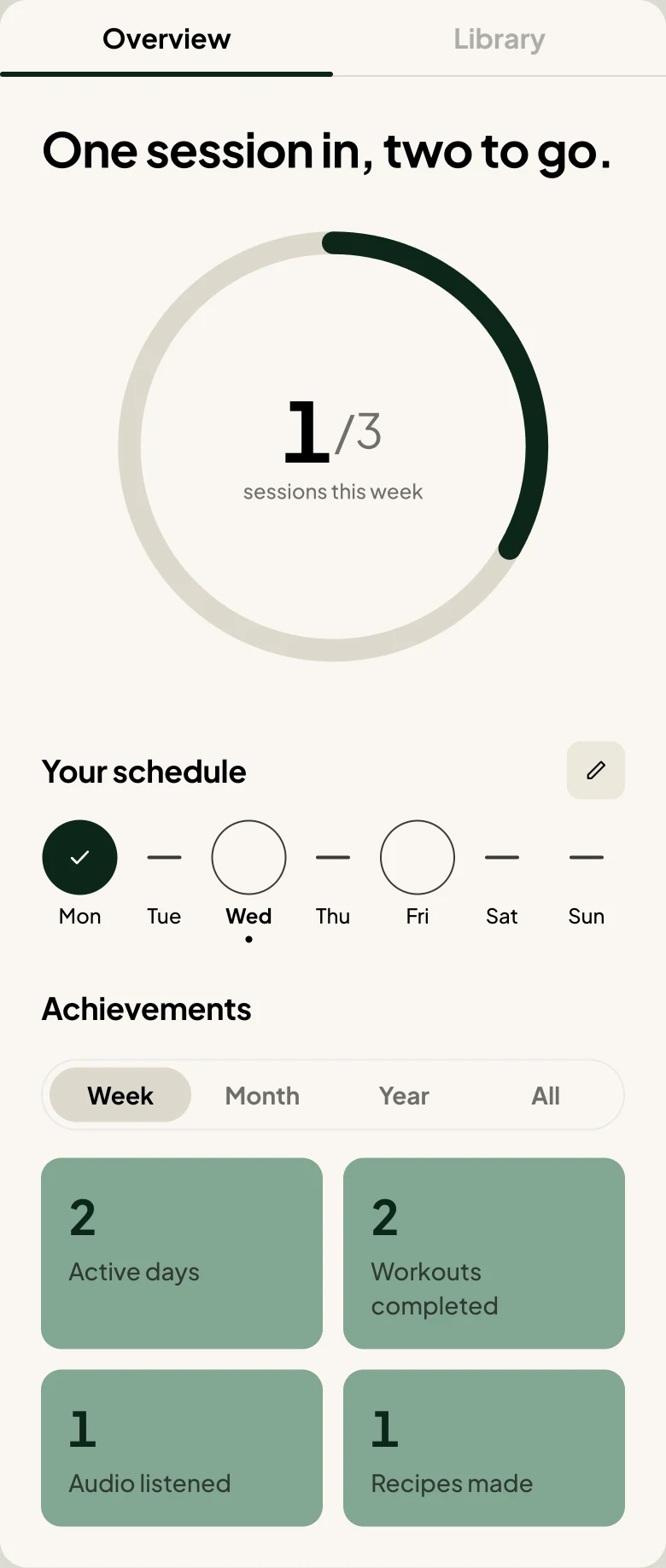
One navigation system, organized around how the company works
→ Core Challenge
Redesign an internal people-management platform that suffered from low adoption, unclear workflows, and a visual language that didn’t reflect the company’s technical culture.
The company had fast-growing teams, strong rituals (1:1s, quarterly rocks), and a remote-first environment—but the existing tool wasn’t supporting any of it. Three people on the People team raised the same problem: they couldn’t find what they needed quickly.
That split made the next action obvious instead of making every person navigate the whole platform. Underneath it, a new information architecture organized the product around the company’s actual mental model—people, rituals, and work—so users could predict where something lived and get to it faster.
→ Process
- Workshops to understand rituals, team mental models, and friction points
- Definition of design principles aligned with technical culture
- Complete redesign of information architecture
- Dual-experience model for heavy and light users
- Design system and modular component architecture built from scratch
- Composable dashboard modules that could support different roles without separate products
- High-fidelity mobile + desktop prototypes for alignment
→ Key Decisions
- Built the core experience from composable modules, so heavy and light users could assemble role-specific dashboards from the same system
- Replaced the inherited structure with a new system organized around actions, rituals, and journeys rather than pages and categories
- Defined design principles: fast retrieval, low cognitive load, developer-friendly density
- Split experience between heavy users (managers, ops) and light users (new joiners), allowing high-density dashboards and simplified onboarding to coexist
- Created a bold, developer-friendly visual identity that finally matched the internal culture
- Emphasized clear hierarchy, subtle motion, and predictable patterns to reduce cognitive load
Quality checks happen while the work is being written
→ Key Insight
The platform was failing because its mental model didn’t match how teams actually worked. Reframing the IA around rituals rather than modules fundamentally changed how intuitive the product became.
This allowed both heavy and light users to share the same system without compromise.
The same module changes with the responsibility of the person using it

→ Outcomes
- A unified platform concept that finally connected people, rituals, and work into one coherent home
- A design system that repositioned the tool from bureaucratic HR software to a developer-friendly internal product
- Stakeholders aligned around a clearer product direction with defined adoption pathways for both heavy and light users
- A reframed product vision strong enough to guide future implementation once engineering resourcing becomes available